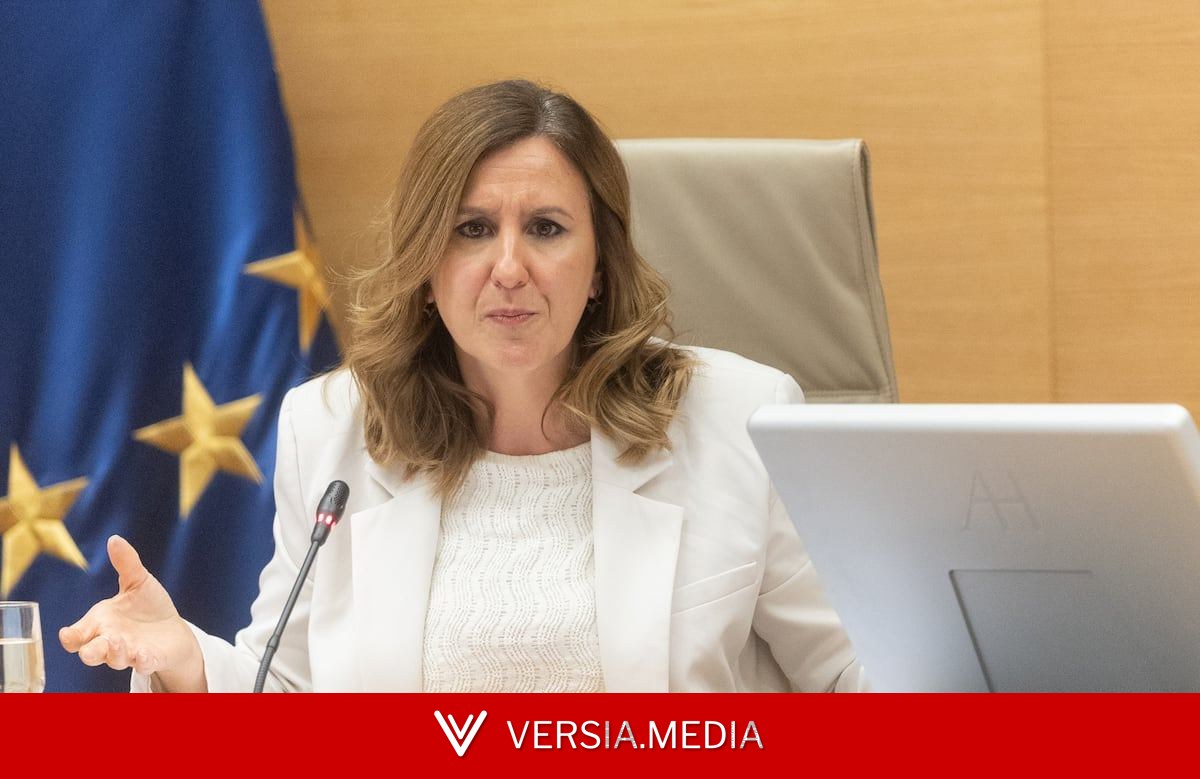
María José Catalá defends the actions of the former president during the dana investigation committee and points out that the flood plan relied on “outdated cartography”
This Monday, deputy Àgueda Micó from Més-Compromís brought a small photo frame to the Congress bearing the image of former president of the Generalitat Valenciana Carlos Mazón kissing current Valencia mayor María José Catalá on the cheek. Facing Micó, Catalá testified this Monday as a witness in the congressional investigation into the dana’s management. “I bring out the photo to remind you of your relationship with the former president. You said the following in the media: ‘I fully support him. He is doing a great job in reconstruction, and of course, I believe this persecution, this personal attack does not help.’ After everything the former president Carlos Mazón did, after all the lies, do you stand by your statement that he was the best for the Valencians?” Micó asked the mayor reproachfully.
—Former president Carlos Mazón was the only one who assumed political responsibilities in this unfortunate phenomenon. What he did right or wrong, he already took responsibility for. I think there are people who must assume their political responsibilities, but that is your business...
—You keep him protected in the Valencian Parliament —Micó replied.
—That is a personal decision.
The shadow of the former president loomed over part of the session. What he did on that October 29, 2024, and what he did not. Also the lies (and denials) that Mazón uttered during the weeks following the floods that caused 230 victims.
These words once again highlight the string of versions that the Valencian president and his government tried to maintain for months before the media: that he was always operational, that he worked at the Palau from five in the afternoon, and that the government sent the mass mobile alert when it learned of its existence, close to nightfall that day. The reality is that the former president was at a meal with a journalist until after seven and did not arrive at the Cecopi until after 8:28 p.m., nearly fifteen minutes after the Es-Alert had been sent and when more than 154 people had died and for dozens more their situation was hopeless.
But when Catalá was asked about Mazón’s versions or whether she stood by her supportive statements — such as the one that the former president was among the first to “go down into the mud” to be with residents — she repeatedly responded with the phrase “he has assumed his political responsibilities.”
The mayor of Valencia also clung to the version of the Valencian government of the Popular Party: there was insufficient information to act. In her case, to warn citizens of the hamlets of Forn d’Alcedo, La Torre, and Castellar Oliveral. “The first alert the Local Police received was at 8:04 p.m., and it was due to an incident report from Valencia Sud,” Catalá responded. At that time, according to an investigation by this newspaper, 142 citizens had already died. When asked why she did not use the public address system to warn residents — a system the city council has used on other occasions — the mayor again defended that she did not know what was happening: “If no one warns Valencia that a flood is coming, who do I tell to go warn people via loudspeakers?” In the territory where she was in charge as mayor, 17 people died.
The mayor defended her management: that she was the first mayor in the Valencian Community to call those who were then the emergency councilor, Salomé Pradas, and the emergency secretary, Emilio Argüello. Also that she took measures when Aemet declared the orange emergency level (closing parks, schools...) and that she was among the first councilors to activate the Cecopal (Municipal Operational Coordination Center), the local body that coordinates all actions in an emergency situation. “I was a mayor who was with her residents,” she said.
On the other hand, Catalá attacked the flood plan in effect at that time, which indicated that, in the event of an overflow of the Poyo ravine — the event that triggered most of the deaths — the water would spill into the rice fields and not reach the populated areas. “The plan did not foresee flood risk for the three affected hamlets,” the mayor pointed out, describing the studies underpinning the previous council plan as “outdated cartography.”
Catalá’s denial contrasts with the appearance that preceded her in the afternoon, that of the Secretary General of Civil Protection, Virginia Barcones. The secretary stated that the Valencian government’s disorientation was such that at 9:30 p.m., it still had not sent “relevant data” about the situation. “The Valencian Generalitat is the one with the competence, responsibility, and who communicates to us what is happening. [That day, they told us that] security, no relevant data; health services, no relevant data; logistics, no relevant data,” Barcones specified.
Among other details, Barcones assured that the Valencian government did not communicate to civil protection “at any time the calls that 112 was receiving.” The incidents recorded at the 112 center were a thermometer of the tragedy that measured minute by minute what was happening in each town. That day, 19,821 calls were recorded, of which more than 15,000 occurred before the first alert was sent. At five in the afternoon — when the Cecopi (Integrated Operational Coordination Center) meeting began — 9,500 distress calls had already been logged, and the operators were aware that dozens of citizens were drowning.
The secretary defended that that day she was not on a “pleasure trip” but on a work trip, en route to Rio de Janeiro (Brazil) to attend a G20 meeting. Barcones answered many questions that have already been addressed over the past year, such as the request for UME intervention by the Valencian government, which initially made the mistake of requesting “demobilization” in the form. The error, the secretary clarified, was quickly resolved because the government delegation in the community had already warned Civil Protection that its services would be required.
About the signature
More information
“It was chaos”: the president of the Júcar Confederation recalls the Cecopi meeting during the dana in Congress Julio Núñez | Madrid
“It was chaos”: the president of the Júcar Confederation recalls the Cecopi meeting during the dana in Congress
Mazón’s driver declares that he picked him up at the Palau “around eight,” when most of the dana victims had already died Julio Núñez | Madrid
Mazón’s driver declares that he picked him up at the Palau “around eight,” when most of the dana victims had already died
Archived In
Spain
Floods
DANA floods October 2024
Disasters
Valencia
Generalitat Valenciana
Victims
Senate
PSOE
PP
Vox
Podemos
Podemos Valencia
Sumar